I have listened to a frankly absurd number of ChatGPT responses.
I rarely read the responses with my eyes. Partly because I suspect I have an underlying reading difficulty somewhere in the dyslexia department, that I’ve compensated for my entire life, and partly because my astigmatized eyeballs are aging and I’m in denial. The reason I’m able to partake in any form of learning is all thanks to – drummroll – Microsoft Edge with Read aloud for PDFs and Wavenet for the rest. Where were we..?
Ahh, yes, so I press Read Aloud, every turn, every time, every day hundreds of times.
This is not a productivity hack. I cannot listen to something and do anything else at the same time. ADHD makes sure of that. If I’m listening to a seven-and-a-half-minute text-to-speech output, I’m listening for seven-and-a-half minutes. Someone else can skim a wall of text in a minute. I have to sit there and hear the whole thing at spoken speed. I’ve tried speeding up playback on my iPhone, but the web UI doesn’t give me the speed controls.To further demonstrate the level of distractibility: I tried listening to a voice note from my best friend while on the loo. The experience was too distracting, so I had to go back and listen again, because apparently I had flushed the listening comprehension with the payload.
After spending that much time listening to AI-generated paragraphs, I’ve developed an ear for “the explainer by ChatGPT”: its distinctive cadence, the transitions, the hedging, and the peculiar runway to an argument that seems to apologise for its existence before it has had a chance to fully form.
Which brings me to:
YouTube
I’m watching a tech explainer. There’s a human face explaining a paper to me in a human voice, as someone explaining a research paper would. All perfectly ordinary.
Then I hear it.
The cadence of someone confident enough to make a statement, but prefacing it with every possible caveat and uncertainty. The transitions. The pre-emptive justification before making a point: “This matters because…”
The hedging: possibly, perhaps, it may be tempting to think, but the reality is more nuanced.
The bold statements have been softened so thoroughly, in the hope of not upsetting anyone, that the whole argument has apologised itself into an absolute bowl of oatmeal.
I have listened to the whole thing. And I have a question:
Okay. Is this your script and your opinion, or could I have just asked ChatGPT?
I have absolutely nothing against AI
God knows I use the stuff.
I use ChatGPT on practically every string of letters that might be seen by a fellow human. I ask it to help me articulate ideas, challenge my predispositions, and make me research deeper to avoid sounding like an opinionated idiot. But most often I ask it to make the prose behave like language. English is officially my third language, and I possess the fine motor skills of a dropped toddler paired with the spelling skills of a Year 1 ESL student enthusiastically giving it a go.
This matters because… 👀
Sometimes the model makes a legitimate correction. Sometimes it catches me being sloppy. Sometimes it improves the argument.
Sometimes it takes a simple concept like “readability” and mangles it into an editorial-sounding triplet, demonstrating its ability to say things in three different ways for no added depth. (For a working example, see the statement above this one.)
Snarky fluff aside, I believe metacognition begins with distinguishing your own thinking from the model’s output. For me, that means:
I own my opinions. I own my thesis. I’ll defend it, and I’ll accept the consequences of being wrong.
And I’ll fight the model when it tries to water down my position into something more general, more palatable, more technically nobody could possibly disagree with this flavour of oatmeal.
When I publish the result, I own it. That means checking the claims, choosing a tone and point of view, and accepting responsibility for what I’ve put into the world.
So when I watch a YouTube explainer that sounds suspiciously like ChatGPT, I want to know:
Did the creator read the paper, interrogate its methodology, decide which findings matter, and form an opinion? Did they use ChatGPT or NotebookLM to help organise their understanding, then write a script that reflects their own conclusions?
Or did they paste a link, generate an explanation, read it aloud, and publish it?
First approach demonstrates intellectual ownership. The second resembles a content-farm strategy like 5-Minute Crafts: keep pumping out content, regardless of substance or point of view.
I hope the influencers of the future are the ones who engage with a topic critically, form an opinion, and dare to make a statement. (One can dream.)
Who owns the output?
I’ve made essentially the same argument to teachers during an AI professional-development session for a multi-campus K–12 school in Cambodia:
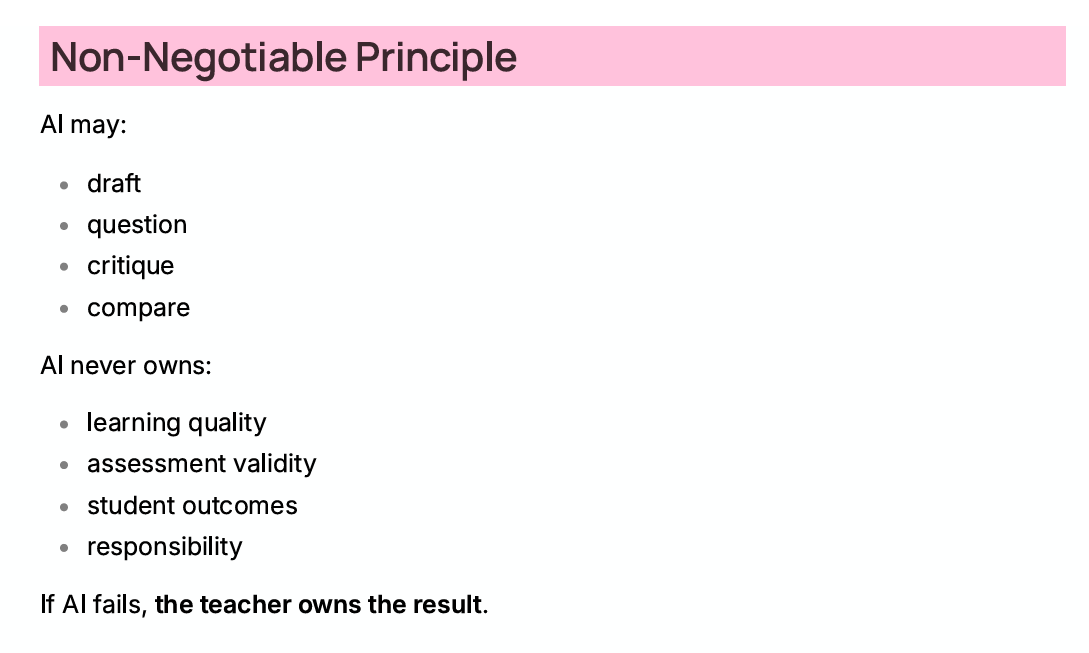
Quote from the professional-development session. Download the handout here.
I see no difference between a classroom teacher and a YouTuber claiming to explain a topic. Both occupy positions of authority and benefit from a degree of blind trust: the audience assumes they’ve done their due diligence and actually read the paper they’re explaining.
I’ll finish with a quote from Cory Doctorow:
There simply is no substitute for learning about a subject and coming to understand it well enough to advance the subject, whether by contributing your own additions or by critiquing its flaws. That’s not to say that we shouldn’t aspire to participate in discourse about areas that seem interesting or momentous – but asking a chatbot to contribute on your behalf does not impart insight to you, and it is a gross imposition on people who have taken the time to understand and participate using their own minds and experience.
— Cory Doctorow, “No one wants to read your AI slop”, Pluralistic, 2 March 2026.